

If you refuse to use self‑checkout lanes, you might have these 5 core tendencies

The march of retail automation has been swift. From barcode scanners in the 1970s to today’s AI-enabled smart carts, every new tool promises faster, leaner, cheaper shopping.
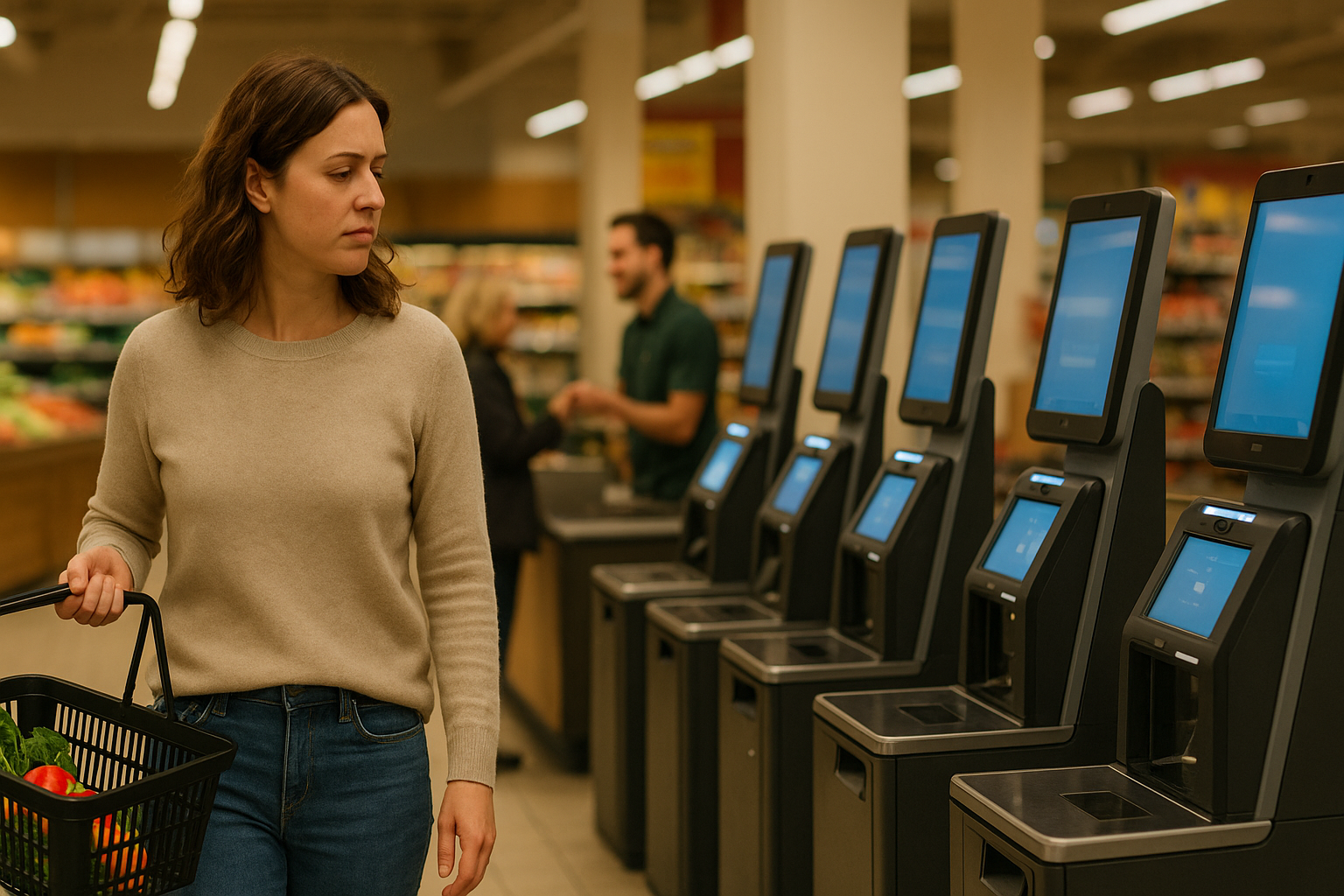
Yet a stubborn subset of customers still steers their trolley straight past the glowing kiosks and queues for a human cashier.
At first glance this looks like mere habit—or maybe technophobia. Dig a little deeper, though, and a richer psychological portrait emerges.
Recent surveys, academic studies and industry reports reveal that people who consistently refuse self-checkout share several stable tendencies that shape how they think, feel and behave in everyday life.
Below are five of the strongest.
1. A deep need for micro-connection
Humans are wired for relatedness, even in fleeting encounters.
Research from Drexel University shows shoppers who choose staffed lanes report a stronger “sense of entitlement to interpersonal service” and—perhaps surprisingly—greater loyalty to the store afterward.
In practice, these are the customers who greet the cashier by name, crack a quick joke, or simply enjoy hearing “Have a nice day” from a real voice. The checkout becomes a scheduled dose of social vitamin C in an otherwise hurried, transactional world.
Psychologists link this to attachment theory: when our basic need for connection isn’t met elsewhere—say, in remote work or online life—we compensate by seeking small but reliable interactions.
Refusing self-checkout is an easy, publicly acceptable way to guarantee that dose.
Over time it becomes an identity marker: I’m the kind of person who talks to people, not machines.
2. High risk-aversion and a desire for control
Self-checkout puts the onus on shoppers to scan correctly, weigh produce, and troubleshoot errors while a red light flashes overhead. For those high in risk-aversion, that spotlight feels punishing.
A design-research review for ECR Retail Loss found that visible mistakes and the fear of public embarrassment deter certain shoppers more than minor time savings can entice them.
Underlying the refusal is loss-aversion, a cognitive bias discovered by Daniel Kahneman and Amos Tversky: we feel the sting of potential losses more than the pleasure of equivalent gains.
The “loss” here is multifaceted—embarrassment, accidental overpayment, or being accused of shoplifting.
Add in the fact that many self-checkout stations still require staff intervention for age-restricted items or barcode misreads, and anxious minds conclude it’s safer to let a trained professional take the wheel. So they do.
3. Solidarity with frontline workers and moral resistance to labor-offloading tech
When you hand your basket to a cashier, you’re also handing them job security—at least symbolically.
Analyses by researchers at the University of Delaware estimate that 6 to 7.5 million U.S. retail jobs could be automated away, with cashiers at highest risk.
A 2025 Pew survey likewise found that 73 percent of U.S. adults believe AI will “probably” mean fewer cashier jobs within 20 years.
For a sizable minority of shoppers, refusing self-checkout is an act of everyday ethics.
They don’t want to participate in technology that makes workers redundant or shifts unpaid labor onto customers.
Social psychologists call this moral identity centrality—when caring about fairness and the welfare of others sits near the core of who you are.
Such individuals often boycott brands that violate labor standards or loudly tip service workers. In the grocery aisle, they stay in the staffed lane.
4. Automation anxiety and low tech self-efficacy
A cross-national study of “fear of automation” found that individuals with lower income, less education, or prior negative tech experiences score significantly higher on automation anxiety scales.
That anxiety translates into concrete behavior: if you expect a machine to confuse you, you’ll avoid it.
Compounding the issue is self-efficacy—one’s belief in their own ability to perform a task. Shoppers who fear mis-scans, barcode gymnastics or sudden system freezes rate their tech self-efficacy as low and walk away.
The refusal is not just about this one kiosk; it generalizes to ATMs, airline check-in machines, even smartphone settings menus. What looks like stubbornness can, from the inside, feel like self-preservation.
5. A fairness mindset that rejects “doing the store’s job for free”
Management scholars at Wharton note that self-checkout helps retailers cut costs largely by transferring labor to the customer—an economic sleight of hand that many shoppers notice and resent.
Social-exchange theory predicts precisely that reaction: if people perceive an exchange as unequal, they withdraw cooperation.
Those who hold strong equity norms believe rewards should be proportional to effort. They scan the aisle, see no discount for DIY checkout, and decide my time is worth more than the pennies the store saves.
In effect they are drawing a hard boundary around their labor and insisting on a paid employee to complete the transaction.
Anthropologists point out that this stance also preserves traditional role identities—shopper and sales clerk—which self-checkout blurs to the point of discomfort.
Conclusion
Self-checkout lanes are here to stay, but they are not a universal solution. Roughly a quarter of shoppers still prefer human cashiers, and the five tendencies above help explain why.
Some crave genuine—if brief—human warmth. Others dread the public fiasco of a mis-scan.
Many refuse on ethical grounds, worried about cashier livelihoods or the creeping expectation that customers must do unpaid work. Still others feel overwhelmed by technology or bristle at what they see as an unfair exchange.
Understanding these motives isn’t just academic. Retailers that value long-term loyalty should keep at least a few manned lanes open, train empathetic staff, and design self-checkout systems that minimize error anxiety and clearly reward the customer’s extra effort. Shoppers, meanwhile, can use this insight as a mirror.
If you find yourself avoiding those glowing kiosks, ask which of these tendencies resonates most.
Recognizing the “why” can turn a mundane checkout trip into a small act of self-understanding—and perhaps even empathy for those on the other side of the till.
