

The reason your aging father may not throw anything away may not be stubbornness – every object in that garage is a chapter of a life few people ask about anymore

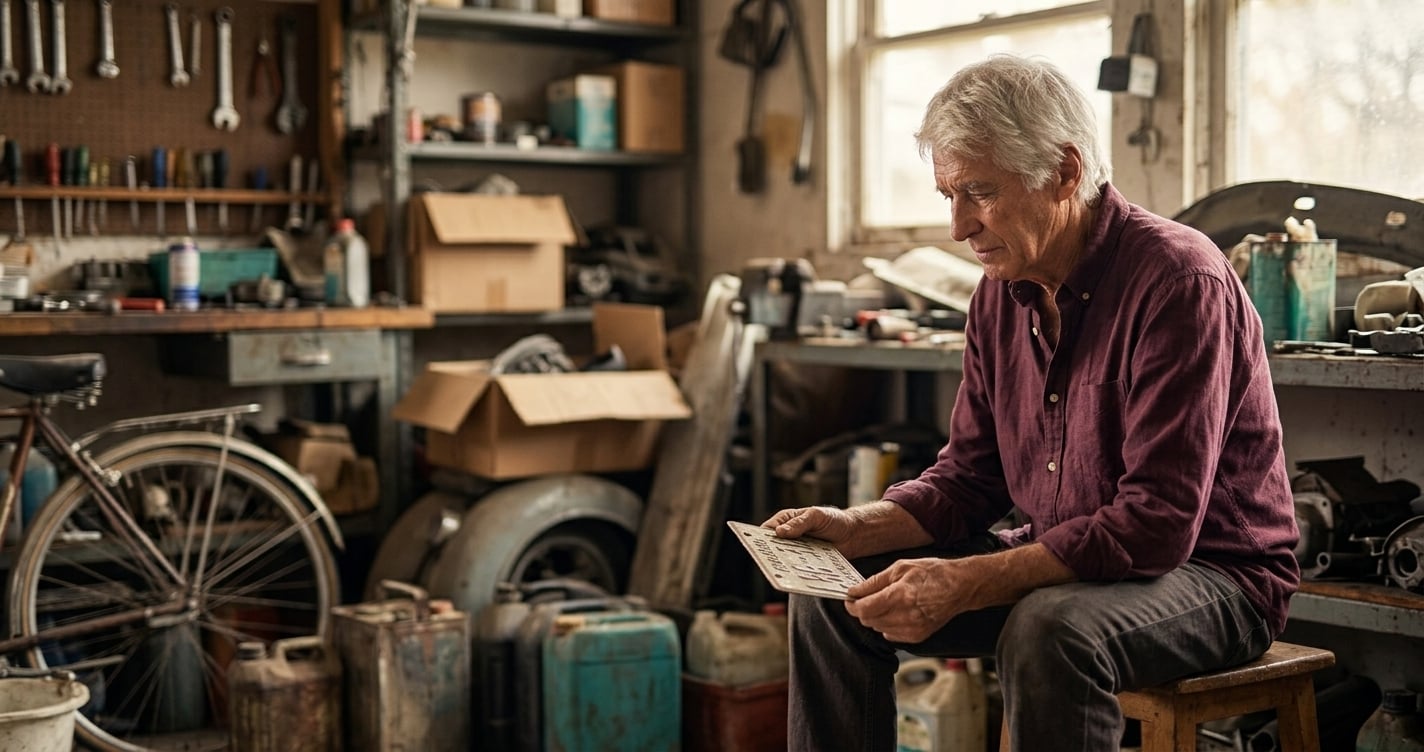
You’ve had the conversation. Maybe more than once. The garage is full. The shed can barely close. There are boxes in the spare room that haven’t been opened since the Clinton administration, and every time you suggest clearing some of it out, he gets quiet. Or irritable. Or both.
You think it’s stubbornness. Maybe a touch of hoarding. Maybe just the old-man refusal to change anything about anything, ever.
But the psychology of why older adults hold onto possessions tells a different story. And it’s one worth hearing, because underneath every rusted tool and stacked box of magazines, there’s often something much more human than clutter.
There’s a life that nobody asks about anymore.
Possessions as autobiography
Here’s what most people don’t realise about older adults and their relationship to objects. Research on object attachment across the lifespan traces a developmental arc that starts in childhood. As toddlers, we form bonds with transitional objects like blankets and stuffed animals. In adolescence, possessions become reflections of who we are. In adulthood, they become markers of what we’ve accomplished. And in old age, our possessions become mementos of life: an aid to reflection and nostalgia, as well as a source of comfort.
That last phase is the one that matters here. The research describes how as adults age, they may have increased sentimental thoughts toward their possessions. If an older adult cannot find an object linked with a core memory, they may feel as though they will not remember an important event or person. The tools from the job he retired from. The fishing rod from the trips with his father. The boxes of slides from holidays nobody remembers but him.
These objects aren’t clutter. They’re repositories of autobiographical memory. Research on emotional attachment to possessions identifies several facets of how people bond with objects, including using them as extensions of identity and as preservation of autobiographical memories. The object holds the memory in place. Letting go of the object feels like letting go of the memory. And when you’re at an age where new memories are harder to form and old ones feel increasingly fragile, that’s not irrational. It’s protective.
The life review nobody asked for
In the 1960s, psychiatrist Robert Butler introduced the concept of life review, a naturally occurring process in later life where older adults reflect on and evaluate the significant events of their entire lifespan. Butler argued that this wasn’t pathological rumination. It was a developmental task. A necessary reckoning with who you’ve been and what it meant.
Life review therapy, which grew out of Butler’s work, uses tangible prompts, old photographs, household objects, music from the past, to stimulate memories and facilitate reflection. A comprehensive review in Ageing and Society identified three types of reminiscence that relate to mental health. The positive functions include the integration of memories into identity and the use of past memories to find meaning. The negative functions include using memories to reduce boredom or revive bitterness.
In other words, the process of looking at old things and remembering isn’t indulgence. It’s identity maintenance. And for men of a certain generation, men who were taught that feelings are private and the past is what you move on from, the objects in the garage may be the only life review they’re doing. Because nobody taught them to do it with words.
Your father isn’t hoarding old tools. He’s keeping the evidence that he existed. That he built things. That he was useful. That his hands did something that mattered.
The loneliness underneath the keeping
Research on interpersonal factors in hoarding found that loneliness and reduced social networks are associated with greater difficulty discarding possessions. The link isn’t hard to understand. When you feel connected to people, you carry your identity in those connections. When the connections thin, you carry it in things.
And the connections do thin. Retirement removes the daily structure of colleagues and purpose. Friends move, decline, or die. Children grow up and get busy. The phone rings less. The visits shorten. And the man who spent forty years being needed by everyone suddenly finds himself in a quiet house with nobody asking what he thinks about anything.
The Harvard Study of Adult Development, running for over 85 years, consistently found that the quality of close relationships is the strongest predictor of health and happiness in later life. Robert Waldinger, the study’s director, noted that loneliness is as dangerous to health as smoking half a pack of cigarettes a day.
Now think about the man in the garage. He’s not talking about his feelings. He’s not calling a therapist. He’s not joining a social group. He’s sitting with his things, and his things are sitting with him. Each one a quiet companion. Each one a witness to a version of himself that somebody, somewhere, once valued.
That’s not stubbornness. That’s a man trying to hold onto himself.
What the objects are really saying
I think about my own father sometimes when this topic comes up. And I think about my father-in-law here in Saigon, who keeps every piece of paperwork he’s ever received in neat stacks along the wall of his office. Receipts from 2003. Letters from government departments that no longer exist. Certificates for courses completed decades ago.
When I first saw it, I thought it was just a cultural difference. Vietnamese bureaucracy requires paperwork, so you keep everything. But the more I watched, the more I noticed something else. He goes through those stacks sometimes. Not looking for anything specific. Just touching them. Reminding himself.
In Buddhism, there’s a concept called saṅkhāra, which refers to mental formations, the accumulated patterns and imprints that shape how we experience reality. Our possessions become saṅkhāra in physical form. They’re not just things. They’re materialised memory. They’re proof that we were here, that we did something, that it mattered.
The research on reminiscence and wellbeing shows that actively reflecting on personal history, particularly when prompted by tangible objects like photographs, household items, and music, can improve mood, reduce depression, and increase life satisfaction in older adults. The objects aren’t the problem. They’re the prompt. And the prompt is doing important psychological work, even when it looks like clutter from the outside.
The question nobody thinks to ask
Here’s what I wish more adult children understood. Your father’s garage isn’t a mess. It’s a museum with no visitors.
Every rusted tool has a project behind it. Every box of old magazines has a period of his life when those ideas mattered to him. Every stack of records, every coil of rope, every jar of sorted screws represents a competence that the world no longer requires from him but that he hasn’t stopped carrying inside.
And the reason he gets irritable when you suggest throwing it away isn’t that he’s being difficult. It’s that you’re proposing to erase chapters of his story without having read them.
Research on the effectiveness of reminiscence-based interventions in cognitively intact older adults found significant improvements in self-esteem and psychological wellbeing. The interventions used tangible prompts to facilitate the recall and sharing of autobiographical memories. The sharing part is crucial. Reminiscence works best when it’s interpersonal. When someone else is listening.
The man in the garage doesn’t need an intervention. He needs an audience. Someone to pick up the old hand plane and say: where did you get this? Someone to point at the fishing rod and ask: what was the biggest thing you ever caught? Someone to sit down next to the boxes and say: tell me about this.
Not “can we get rid of this.” Tell me about this.
What you can do
I’m not saying never declutter. I’m saying understand what you’re asking him to do before you ask him to do it. You’re not asking him to throw away objects. You’re asking him to let go of evidence. Evidence of competence, of youth, of relevance, of a version of himself that the world has moved past.
Becca Levy’s research at Yale on stereotype embodiment theory found that older adults who internalise negative age stereotypes, including the belief that they’re no longer capable, relevant, or useful, have worse health outcomes and shorter lives. The man who feels his life story still matters is healthier than the man who’s been told, implicitly or explicitly, that his best years are behind him.
So before you start sorting, start asking. Sit with him in the garage. Pick something up. Let him talk. You might hear a story you’ve never heard before. You might learn something about the man who raised you that you never thought to ask.
Because the things in that garage aren’t junk. They’re chapters. And the saddest part isn’t that he’s keeping them.
The saddest part is that nobody’s reading them anymore.
The real clutter
In the Pali texts, the Buddha spoke about upādāna, clinging. The tendency to grasp at things, experiences, and identities as if they could protect us from impermanence. And yes, there’s a dimension of that in every overstuffed garage.
But there’s another kind of clutter that’s worse. The clutter of assumptions. The assumption that an old man’s possessions are meaningless. That his attachment to them is pathological. That the best thing you can do for him is clear it all out and make the space “functional” again.
The space is functional. It’s functioning as a library. A shrine. A record of a life lived by a man who may not have the words to tell you about it but has kept every artefact in case you ever ask.
Ask.
