

Steve Jobs says the most creative people usually break 5 conventional rules

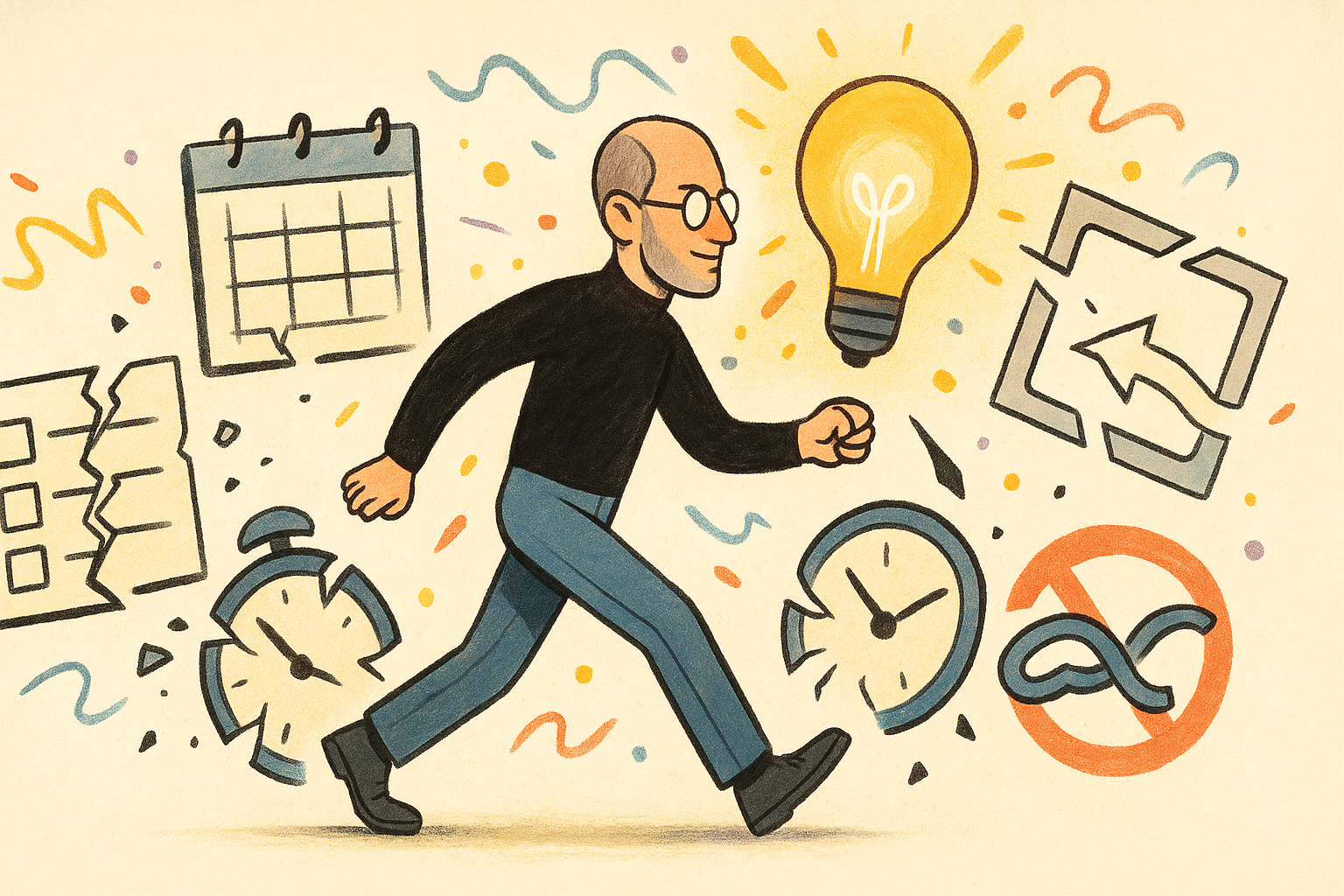
If you had to boil down Steve Jobs’ philosophy on creativity, it might be this: creativity isn’t about coloring inside the lines—it’s about knowing which lines shouldn’t exist in the first place. Jobs repeatedly challenged business dogma, and he left a long paper trail of interviews, speeches, and stories that reveal what highly creative people do differently.
Below are five conventional rules he thought the most creative people break—and how to apply each one.
1) Conventional rule: “Follow the rules and fit in.”
What creative people do instead: Question dogma and refuse to live by other people’s scripts.
Jobs was explicit: “Don’t be trapped by dogma—which is living with the results of other people’s thinking.” That line from his 2005 Stanford commencement address is the cleanest articulation of his belief that creativity starts where conformity ends.
He also co-launched Apple’s “Think Different” campaign, whose manifesto lauds “the crazy ones… the misfits… the rebels… the troublemakers… the ones who see things differently… they’re not fond of rules.” Whether voiced by Richard Dreyfuss on TV or by Jobs himself in an internal cut, the message reflected Jobs’s own creative stance: respect the mission, not the status quo.
How to apply it
-
Treat “best practice” as a starting hypothesis, not a law. Ask, “If no one had done it this way before, would we choose it now?”
-
Make “rule-finding” a habit: when you feel friction, write down the hidden rule you’re obeying (e.g., “we must ship with feature X”) and test whether reality truly requires it.
2) Conventional rule: “Build what customers say they want.”
What creative people do instead: Lead customers by showing them what they’ll love—then iterate.
Jobs famously rejected the tyranny of the focus group. “It’s really hard to design products by focus groups. A lot of times, people don’t know what they want until you show it to them,” he said in a BusinessWeek interview.
This wasn’t arrogance for its own sake; it was a creative process point. Jobs believed creativity connects dots others haven’t yet seen. In a 1996 Wired interview he said, “Creativity is just connecting things,” explaining that creative people synthesize experiences in ways that seem obvious only in hindsight.
How to apply it
-
Start with a strong point of view (POV) prototype that embodies a bet about delight. Put it in front of users to observe behavior (not opinions) and refine from there.
-
Replace “What feature do you want?” with “What job are you trying to get done?”—then design the simplest path to that outcome and demo it.
3) Conventional rule: “Say yes to more opportunities to maximize upside.”
What creative people do instead: Say “no” to almost everything so you can go deep on the few things that matter.
Jobs argued that focus is an act of subtraction: “People think focus means saying yes to the thing you’ve got to focus on… It means saying no to the hundred other good ideas.” In his words, “Innovation is saying no to 1,000 things.”
He repeated the same principle in the press, telling BusinessWeek that creative excellence comes from “saying no to 1,000 things” so you don’t drift onto the wrong track.
How to apply it
-
Keep a Not Doing list next to your roadmap. Every new idea must displace something already on the list.
-
Time-box exploration. Give yourself a short window to survey options, then commit and shield the team from “just one more good idea.”
4) Conventional rule: “Originality means inventing everything yourself.”
What creative people do instead: Remix relentlessly—steal the best ideas and make them your own.
Jobs was disarmingly candid about this: “Picasso had a saying—good artists copy, great artists steal. And we have always been shameless about stealing great ideas.” He said it on camera in the PBS documentary Triumph of the Nerds, then explained that the Macintosh worked because the team drew from liberal arts as well as computer science.
To Jobs, “stealing” wasn’t plagiarism; it was disciplined synthesis—absorbing the best of human achievement and recombining it into something new. That view neatly matches his “creativity is just connecting things” line in Wired.
How to apply it
-
Keep a “swipe file” of interfaces, copy, service flows, and moments of delight from outside your industry. Study why they work, then adapt the underlying principles.
-
In design reviews, ask, “What ‘stolen’ idea are we elevating here?” and “What did we add that makes it unmistakably ours?”
5) Conventional rule: “Don’t ship until it’s perfect—and stick to the plan.”
What creative people do instead: Ship, learn, and trust that the dots will connect in hindsight.
Jobs popularized the mantra “Real artists ship.” Andy Hertzfeld, a key Macintosh engineer, recounts how Jobs used the line to drive the team to finish and deliver, not polish endlessly. The story’s title says it all: “Real Artists Ship.”
Shipping doesn’t mean sloppiness; it means committing to a real deadline, delivering value, and then improving quickly. It also pairs with Jobs’s insistence that creative careers are non-linear. “You can’t connect the dots looking forward; you can only connect them looking backwards,” he told Stanford grads, urging them to trust their gut as they take leaps.
Even his definition of design reinforces this bias toward function and iteration: “Design is… really how it works,” he told Wired, stressing deep understanding over ornament.
How to apply it
-
Define a “minimum lovable product” (MLP), not a “minimum viable product.” What’s the smallest thing that still feels great for a narrow use case? Ship that.
-
Lock scope early and set a public ship date. Use post-launch telemetry and user observation to drive v2/v3 decisions.
Putting it all together
Jobs’s playbook isn’t about theatrics. It’s a set of decisions that channel scarce creative energy:
-
Break rules that are really just dogma. If a constraint doesn’t serve the experience, question it.
-
Lead with a point of view. You can’t A/B-test your way to a breakthrough that users have never imagined.
-
Protect focus. Every “no” is oxygen for the one thing that could become insanely great.
-
Remix boldly. Study excellence anywhere you find it and integrate it into your work.
-
Ship, then sharpen. Deliver something wonderful, learn, and keep improving. The path won’t look straight until you look back.
A few real-world prompts you can use with your team this week
-
Kill a “fake rule.” Ask everyone to write down a rule they assume is fixed (“we always need X integration to launch”). Identify one you can safely break for a limited test.
-
POV demo day. Instead of a research deck, ask for three clickable concept demos that embody a bold opinion about what would delight users. Watch people use them; let behavior, not words, guide v2.
-
The “1,000 Nos” review. Bring a list of good ideas you declined this quarter and why. If the list is short, your focus probably isn’t.
-
Swipe-file hour. Each team member shares one “stolen” idea from outside your industry and the principle behind it. Then pick one to adapt this sprint.
-
Ship a lovable slice. Choose one narrow journey. Define an MLP, set a public date, and ship. Then book a post-launch review to decide the next 2–3 improvements.
Why this approach works
Jobs’s principles are internally consistent. If creativity is “connecting things,” then breadth of experience and freedom from dogma matter. If users often can’t articulate what they’ll love, then POV-led prototyping beats focus-group wish lists. If deep work produces breakthrough quality, then ruthless focus is oxygen. If originality is recombination, then remixing is a feature, not a bug. And if great products emerge through cycles of making and learning, then shipping is the only way to get smarter.
Jobs didn’t just talk about these ideas; he lived them—from “Think Different” to the Mac and beyond. None of this guarantees a hit. But if you adopt his stance toward rules, you’ll give your team the conditions creativity needs: clarity, courage, and the willingness to ship.
