

Ernest Hemingway’s daily writing output was around 500 words, and he made a point of stopping each session when he knew what would “happen next”

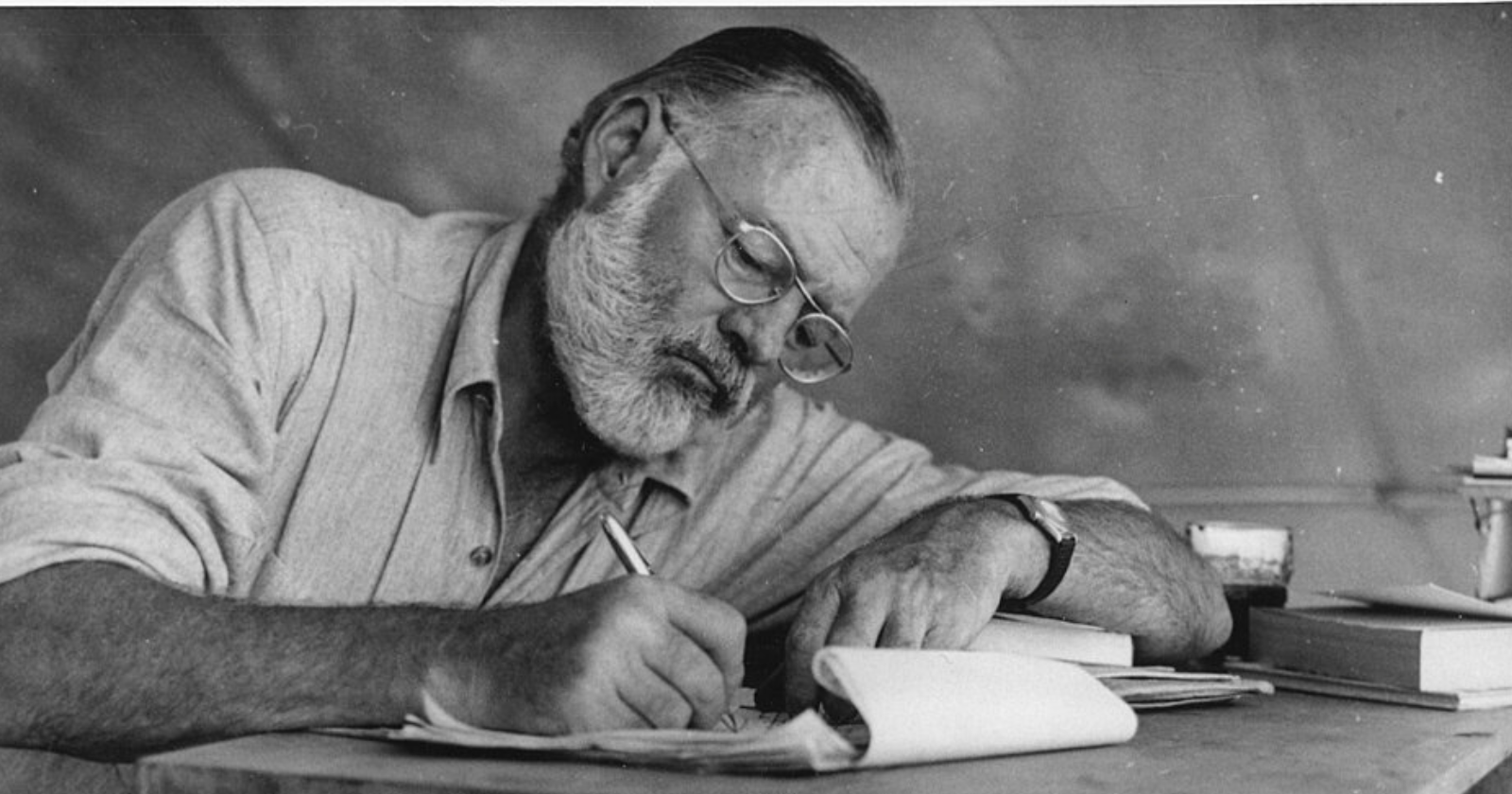
One of most common complaints I hear from people who work alone in somewhat creative jobs is some version of the same thing: I sit down in the morning, and the first thirty or forty minutes are spent staring at the cursor before any actual work gets done. Some days the staring takes ninety minutes. Some days the work never quite starts at all and gets quietly handed off to the afternoon, where it loses to lunch.
The standard advice you hear for this is some flavor of “show up and push through.” Wake up earlier. Be more disciplined. Treat your work like a job and just start. The advice is not wrong, exactly. It is just operating on the wrong end of the day.
Ernest Hemingway, who knew something about the blank-page problem, solved it from the other direction. In his Paris Review interview with George Plimpton, he described the daily working principle this way: “You read what you have written and, as you always stop when you know what is going to happen next, you go on from there. You write until you come to a place where you still have your juice and know what will happen next and you stop and try to live through until the next day when you hit it again.”
Notice what he is doing there. The work of starting tomorrow is being done today, while the engine is already running. The next sentence is not a problem he leaves for his future self to solve at six in the morning, cold; it is a sentence whose first words he already knows, at least to some extent. He puts down the pencil mid-momentum, on purpose, so the next morning the page is not blank. The page is still mid-stride.
The output, in Hemingway’s case, was modest by the standards of writers who measure their day in word counts. Plimpton noted the chart on his wall showing 450, 575, 462, with the occasional 1,250 on days he wanted to fish the next morning.
I’ve started borrowing this trick, though my version of it is less romantic than Hemingway’s. I don’t actually stop mid-sentence — that image of the half-finished clause waiting on the desk like a glass of water for the morning is appealing, but it never quite worked for me. What I do instead is more practical: before I stop, I make sure I know the next move. Not a vague sense of direction, but a specific, named thing — the argument I’m building toward, the transition I can already see, the structural decision I’ve already made. I leave that move as something clear in my mind, then I step away and let it sit.
The gap between sessions turns out to be useful, once there is something in it. Ideas that were only partially formed when I stopped tend to arrive more complete when I come back. The next move I identified before closing the laptop is often a better version of itself by morning or next work session, refined by some background process I had little conscious part in. What looked like a rest is actually a slow cook.
Hemingway’s wording is precise about this: stop “where you still have your juice and know what will happen next.” The known move is the thing that survives the night. What I’ve found is that it often does more than survive — it grows.
It also turns out to work outside of writing. I use a version of it inside work blocks during the day. I work in roughly 90-minute to two-hour sessions, usually in a cafe, and between blocks I walk to a different cafe — partly for the air, partly because the change in environment helps me drop the previous block’s residue. The Hemingway rule comes in at the end of each block. Before I close the laptop or leave the table, I identify the next move clearly enough that it can travel with me: what I’m building toward, where the thread picks up, what question I’m sitting with. The block does not end on a clean stop. It ends on a setup — and the walk between cafes is where that setup often gets better.
The effect is not, on any one block, dramatic. It is the kind of thing you only notice when you stop doing it. Skip the setup at the end of one block, and the next block opens with thirty minutes of trying to remember where you were. Do it every time for a few weeks, and the cumulative effect is that the day moves. The starts of things stop being the expensive part.
I have come to believe the “just show up and push through” advice is mostly aimed at the wrong moment. The hard part of working alone is not the part where you are working. The hard part is the gap between sessions — the morning before the first session, the dead minutes between two blocks. Discipline, the way most people frame it, is a tool for muscling through those gaps with willpower. The Hemingway move is a different idea. It does not muscle through the gap. It shortens the gap, by handing the next session a head start it did not have to earn. And if you’re lucky, the gap does some of the work for you.
It is not magic, of course. The trick fails when too much time passes between sessions; the known move goes cold, and what you identified yesterday as a runway feels alien on Monday after the weekend. It fails when the next move was the wrong move and the morning starts in confidence in the wrong direction. It fails on bigger structural problems that no amount of advance preparation can solve. The Hemingway rule is one small mechanism, not a replacement for figuring out what you are actually trying to do.
But for the specific problem of starting cold, every morning, in a job that nobody else is going to start for you, I don’t think I have found a better one. The version of the day that begins with a known next move — one that has had a few hours to settle and often to sharpen — is reliably easier than the version that begins with nothing at all. The work of starting tomorrow gets done while today’s work is still warm.